India’s cities buy almost nothing new. More than 700 water and waste technology startups sit on the DPIIT register, yet less than 1 percent of municipal contracts go to new technology [1]. At the University of Toronto India Foundation, we read this as a finding about access rather than a finding about talent. Climate entrepreneurship in India is not short of ideas, and it is not short of public money. What it lacks is a legitimate route into the systems it is meant to serve. The city sandbox is the instrument we have designed for that route.
What Exactly Is A City Sandbox?
A sandbox is a bounded zone, system, or dataset that a city formally opens to a cohort of teams. Three elements define it:
- A written problem statement from the city stakeholders
- A named technical steward
It is neither a competition nor a mock project. It exists because a city cannot otherwise open live infrastructure to an early stage founder without triggering a procurement event. The sandbox makes access lawful, bounded, and owned.
According to public data, the commitment on the government side is already substantial (see Appendix 1):
- The Union Budget 2026-27 provides Rs. 2,16,654 crore for water supply, sanitation and river conservation across its major schemes [2]
- Swachh Bharat Mission-Urban 2.0 was approved with an outlay of Rs. 1.41 lakh crore for its 2021-26 mission period [3]
- Rs. 13,415 crore has been released for clean air work across 130 cities since 2019 [4]
The constraint, in our assessment, is not the presence of budgets. It is the absence of a structure through which new technology can meet them.
Who Must Sit Inside The Sandbox For Climate Entrepreneurship To Work?
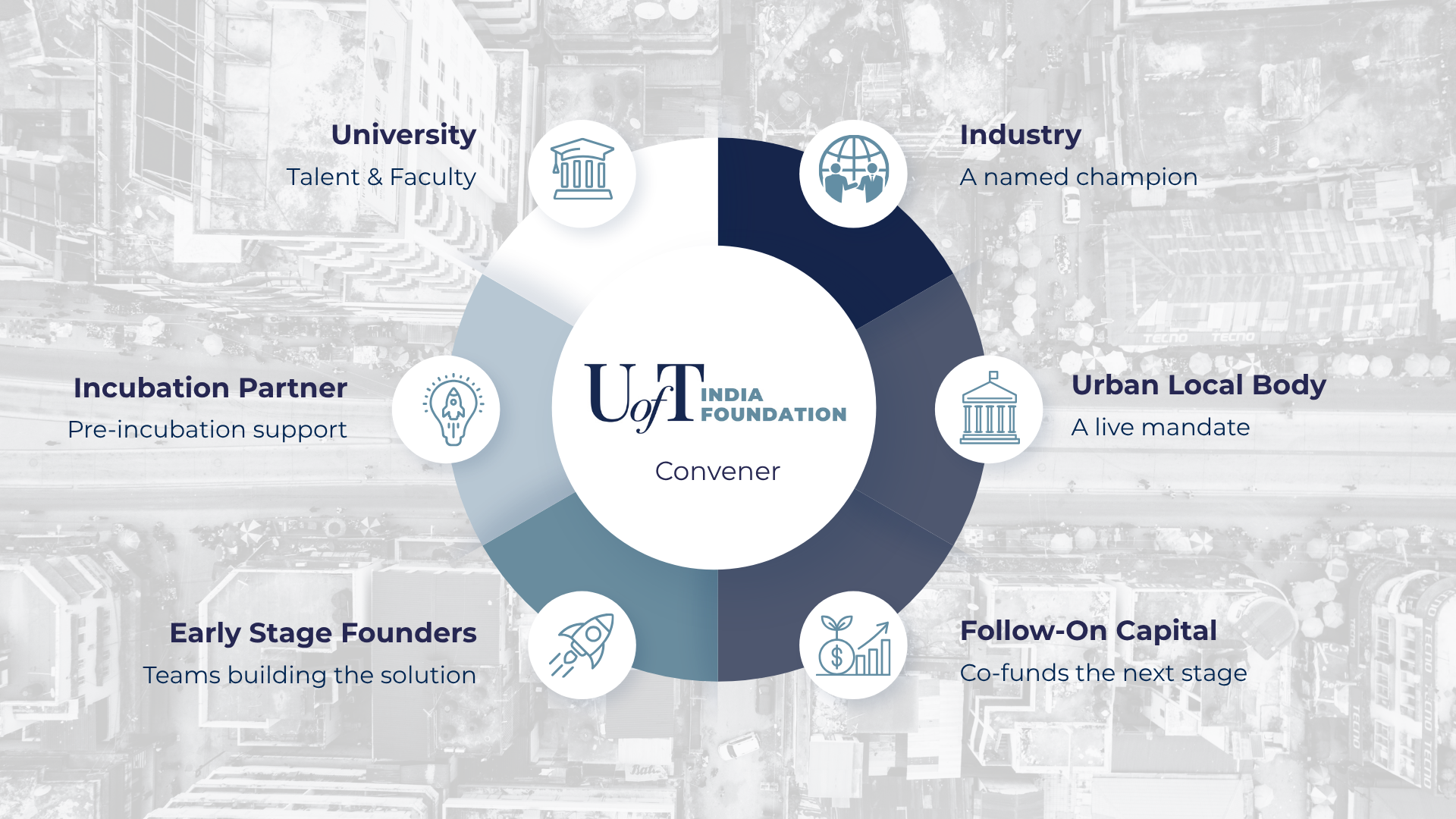
No single institution holds everything this work requires. Universities hold talent, faculty and a credit framework, but not industry access. Pre-incubation partners hold coaching, mentorship and community, but not a founder pipeline or research depth. Cities and industry hold the problems, the budgets and the operational reality, but not the capacity to run programmes against them. The sandbox activates the pentahelix, bringing university, government, industry, enabling organisations and founders into one coordinated structure, and it is the Foundation’s role to hold that coordination between actors who would not otherwise meet.
A working cluster therefore carries seven roles:
- An industry partner with a named champion or A municipal body with a live mandate
- Early stage founders doing the work
- The Foundation as convenor