University of Toronto India Foundation

Challenges to Sustainable Urbanisation in India: A Snapshot
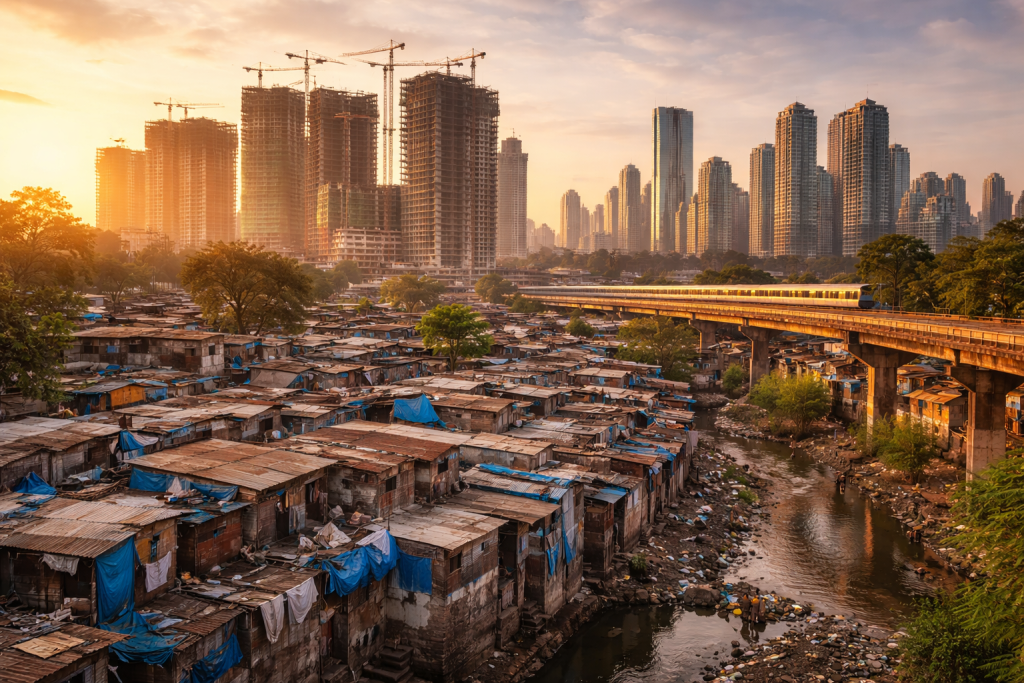
Urbanisation is happening so fast in India–combined with the scale of the growth–that it has never happened before in human history at this rate or scale. Out of over a billion people living in India today, approximately 35.4% are urban; however, the number of urban dwellers will reach 43.2% by 2035. The urban challenges India faces will change how its economy grows, impact its environment, and affect how people interact with others for generations. However, the road to sustainable urbanisation in India is complicated with many different interconnected (and complex) challenges, including infrastructure deficits, governance problems, environmental pressures, and equity issues.
Those interested in helping to solve these urbanisation challenges in India, including policymakers, urban planners, researchers, entrepreneurs, and active citizens, must understand the full complexity of these issues in order to truly contribute towards solutions. The following snapshot highlights the major barriers to achieving sustainable urbanisation in India and is designed to provide a realistic assessment of what needs to take place for any such improvements to occur, not to discourage anyone from their efforts.
The Infrastructure Investment Gap
The magnitude of the investment in infrastructure that is needed for sustainable urbanisation in India has been identified as one of the biggest challenges to achieving this. According to estimates, a total investment of $840 billion will be required for urban infrastructure by 2036, which translates into an average annual investment of about $55 billion, or approximately 1.2% of the GDP. More alarmingly, nearly 70% of the urban infrastructure needed for 2047 still has not been constructed.
There are both challenges and opportunities associated with this. The challenge is to mobilise the necessary resources at the required scale and to ensure that both quality and sustainability criteria are met. The municipal corporations that are primarily responsible for providing this infrastructure typically have limited financial capacity and rely heavily on transfers from the state and federal governments rather than generating revenue from their own sources. The collection of property taxes is inefficient, user fees do not generally cover the cost of providing services, and municipal bond markets are still in their infancy.
Conversely, these challenges present opportunities; the vast majority of the required infrastructure remains to be built. Unlike cities with established urban infrastructure systems that require costly retrofitting, Indian cities have the opportunity to integrate fair and sustainable infrastructure from the beginning, to design climate-resilient infrastructure, to develop circular economy principles, and to integrate equity into these efforts from the beginning. Evidence-based approaches to making these critical infrastructure investment decisions will be promoted through research collaboration and knowledge sharing operated by organisations like the University of Toronto India Foundation.
Yet seizing this opportunity requires overcoming institutional and financial constraints that currently limit municipal capacity. Without substantial reforms in urban financing, governance structures, and technical capabilities, the infrastructure deficit will deepen rather than close.
Climate Vulnerability and Environmental Degradation
Urbanization in India is being greatly affected by intensified Climate Change and Climate-related problems. Urban Heat Islands are causing extremely high temperatures in urban areas, relative to their surroundings, resulting in bad health consequences associated with more frequent heat events globally. The partnership between the UofT India Foundation and Mahila Housing Trust to develop Climate Change Action (Heat Action Plans) for cities such as Jalgaon is an example of efforts to build Urban Climate Resilience, but indicates that efforts are limited when contrasted against the need.
India has many of the world’s worst-rated cities in terms of Air Quality. With cities such as Delhi, Mumbai, and Kolkata, as well as many medium to large cities in India, the levels of pollution regularly exceed acceptable levels. As a consequence, there is a tremendous burden on India’s healthcare system and development of human capital due to the health effects of the pollution, such as Respiratory Diseases, Cardiovascular problems, and Developmental Problems for Children. There are some innovative solutions, for example, air filtration devices and electric vehicles, showing potential; however, making them financially viable and ensuring sufficient infrastructure for implementation are obstacles that need to be addressed before these can be expected to have a meaningful impact.
Groundwater is diminishing at an accelerated rate while surface water sources are becoming increasingly unreliable due to unpredictable weather patterns, and, as a result, cities that were designed based on “historical rainfall averages” are now facing flooding (due to extreme rainfall events) and extended periods of no rainfall where there is a complete lack of available water. The city-wide intermittent water supply systems in many cities across India are causing inequitable distribution to continue to exist, and specifically, are degrading the quality of water by allowing contaminants to enter the water supply; these issues are being addressed by groups such as UofT India through the research that they are doing related to successful continuous water supply models, such as the Odisha Drink from Tap model.
Though the collection, transportation, and disposal systems for solid waste have seen improvements over time, they still do not provide adequate service to the community. Due to the fact that many municipalities lack sufficient infrastructure to collect, transport, and dispose of solid waste, solid waste continues to accumulate in public areas and contaminate sources of fresh water, therefore creating public health hazards. While a number of startups have created new products and services that use innovative waste-to-resource technologies and implement a circular economy approach, changes to consumer behavior, regulatory environments, and municipal operations are required in order to implement such systems successfully; achieving this on a large enough scale presents a significant challenge.
The Housing and Affordability Crisis
Sustainable urbanization in India will require addressing acute housing shortages and the issue of affordability. As the costs of land rise in the inner city of urban areas all the time, affordable housing is moving away from core urban centers further and further into the peripheries, which ultimately results in low-income workers forced to choose between impossible long commute times each day to work or live in informal markets where basic utilities/services are nonexistent.
So far, the Housing for All mission has made progress, though demand greatly exceeds the available supply. More importantly, the housing issue is not only a ratio of units to people, but it is also about where these units are within the context of where people work, are instructed, or see a doctor on a regular basis. Building houses in proximity to their respective work, jobs/schools/healthcare systems does not solve problems; ratherr it shifts those problems from one part of the city to another.
Innovative methods of constructing housing using sustainable materials developed by some local startups participating in efforts supported through UofT India Foundation Programs, particularly the ‘Techtonic Challenge’, are examples of methods for lower-cost, reduced environmental impact construction. However, the issues surrounding regulations that constrain construction, risk avoidance by developers, and access to money have slowed down the adoption of these types of innovations in the housing industry.
The continued existence of informal settlements is a reflection of not just poverty but systemic failures in the following areas: restrictive land use regulations, lack of ability to produce an adequate amount of affordable housing, and weak tenant protections that prevent rental markets from providing appropriate rental opportunities to low-income families. A sustainable urbanization initiative should include completely rethinking and redesigning the way cities offer housing options, and recognizing the need to shift from considering housing exclusively as an economic commodity to recognizing the need for adequate housing to be recognized as a type of infrastructure.
Governance and Institutional Capacity Gaps
Urban governance in India operates within complex, often contradictory institutional frameworks. Municipal corporations possess limited autonomy, depending heavily on state governments for resources and policy direction. The 74th Constitutional Amendment aimed to strengthen local governance, but implementation remains uneven.
Technical capacity within municipal bodies often proves insufficient for contemporary urban challenges. Managing complex water systems, implementing intelligent transportation networks, conducting sophisticated environmental monitoring, and executing climate adaptation strategies require expertise that many municipalities lack. The University of Toronto India Foundation addresses this through capacity-building workshops on data visualization, urban planning methodologies, and evidence-based policy, but such initiatives reach only fractions of those needing enhanced capabilities.
Inter-agency coordination presents persistent challenges. Urban water management involves multiple agencies; transportation planning cuts across departments; climate adaptation requires integrated action across sectors. Yet institutional structures rarely facilitate such coordination, leading to siloed approaches that miss systemic interdependencies.
Citizen participation in urban planning remains limited despite rhetorical commitment. While some cities experiment with participatory budgeting or community engagement processes, most urban development proceeds with minimal meaningful input from affected residents. This deficit undermines both equity and effectiveness, as solutions developed without user input often fail to address actual needs or encounter implementation resistance.
Transportation and Mobility Challenges
Urban mobility in India faces profound challenges: inadequate public transportation, traffic congestion that wastes billions of hours annually, air pollution from vehicular emissions, and transportation networks designed primarily for private vehicles rather than the majority population dependent on public transit, walking, and cycling.
Metro rail systems in major cities represent significant investments, but they serve limited corridors and populations. Bus systems, potentially more flexible and affordable, often operate with inadequate frequency, coverage, and quality. Last-mile connectivity remains particularly problematic, with poor integration between transportation modes creating friction that discourages public transit use.
Non-motorized transport receives minimal priority in urban design. Pedestrians navigate broken footpaths, absent crosswalks, and vehicle-dominated roads. Cyclists risk life in mixed traffic without dedicated infrastructure. This car-centric planning approach proves both environmentally unsustainable and socially inequitable, as lower-income residents dependent on walking and cycling bear disproportionate risks and inconveniences.
Electric vehicles offer potential for reducing emissions, but charging infrastructure remains limited, and electricity generation sources must themselves transition to renewables for genuine sustainability. Innovations like electric conversion kits for commercial vehicles, such as those developed by startups in the Techtonic cohort, demonstrate entrepreneurial responses, yet scaling requires policy support, infrastructure investment, and behavioral change.
Social Equity and Inclusive Development
Perhaps the most fundamental challenge to sustainable urbanisation in India lies in persistent inequity. Cities segregate by income, with affluent neighborhoods enjoying reliable services while lower-income areas face chronic deficits. This spatial inequality perpetuates social stratification and undermines the inclusive development essential for genuine sustainability.
Women face particular urban challenges: inadequate safety in public spaces, limited representation in urban planning, and disproportionate burdens from infrastructure deficits like water scarcity. Urban design rarely accounts for women’s specific needs and experiences, despite their centrality to household management and community wellbeing.
Informal sector workers, who constitute enormous proportions of urban workforces, operate with minimal legal protections, access to services, or political voice. Waste pickers perform essential environmental services without formal recognition or fair compensation. Street vendors face harassment despite providing affordable goods and services. Sustainable urbanisation requires fundamentally reconceiving relationships between formal and informal economies, recognizing informal workers’ contributions rather than seeking to eliminate informality.
Migrants, who drive urban population growth, encounter barriers to accessing services, discrimination, and often exploitative labor conditions. Sustainable cities must become inclusive cities, where all residents, regardless of migration status, caste, religion, gender, or economic status, can access opportunities and services.
The Data and Knowledge Gap
Robust data is needed for evidence-based urban planning. Such data includes demographic data, infrastructure condition data, service quality data, environmental parameters, and social outcomes. Unfortunately, systematic collection & utilization of such data is not very common in cities in India.
UofT Canada has partnered with Tata Consulting for an Urban Data Center. The goal of this partnership is to generate municipal data capacity; however, there are still very few initiatives of this nature.
Without quality data, cities cannot accurately assess their needs and hence will not be able to develop effective investment strategies, measure the success of investments, or adjust investment strategy based upon evidence of what works. As a result, the overall effectiveness and accountability of a city’s planning processes will suffer.
The research gap is not just limited to evidence required for evidence-based planning, but extends to evidence required to determine which planning solutions will work in an Indian context. There are some examples of successful planning solutions from around the world that provide good ideas; however, the development of a successful solution in India will require contextual adaptation. Programs like the U of T India Foundation’s Research Catalyst Grants provide support for research collaboration between Canadian researchers and Indian researchers, which will help create evidence that is relevant to the needs of local citizens; however, the amount of relevant evidence created is small when compared to the magnitude of the problems faced by cities in India.
The Coordination Challenge
Sustainable urbanisation in India ultimately requires coordinated action across multiple domains: infrastructure investment, environmental protection, housing provision, transportation planning, economic development, social services, and governance reform. Yet institutional structures, funding mechanisms, and political incentives rarely facilitate such coordination.
Different levels of government, central, state, and municipal, operate with overlapping jurisdictions and sometimes conflicting priorities. Central government schemes may not align with state priorities; state policies may not match municipal capacities. Effective urbanisation requires vertical integration across governmental levels that current systems struggle to achieve.
Horizontal coordination across sectors proves equally challenging. Transportation planning affects air quality; housing locations influence commute patterns; water management connects to energy systems. Addressing these interdependencies requires holistic approaches that siloed governance structures resist.
Private sector engagement, essential for mobilizing investment and innovation, requires regulatory clarity, risk-sharing mechanisms, and patient capital often absent. Public-private partnerships show promise but also demonstrate pitfalls when improperly structured or executed.
Moving Forward: Challenges as Opportunities
These challenges to sustainable urbanisation in India, infrastructure deficits, climate vulnerability, housing crises, governance gaps, transportation inadequacies, persistent inequity, data limitations, and coordination difficulties, might seem overwhelming. Yet they also represent opportunities for innovation, transformation, and building urban systems fit for the future rather than merely replicating unsustainable patterns.
Organizations like the University of Toronto India Foundation contribute by bridging research and practice, supporting innovations through entrepreneurship programs, building capacities through training, and facilitating knowledge exchange. But addressing challenges at the scale India faces requires sustained commitment from government, civil society, private sector, academia, and citizens working in coordination toward shared visions of sustainable, equitable, livable cities.
The choices India makes regarding urbanisation over the next two decades will shape the nation’s trajectory and influence global sustainability outcomes. Understanding the challenges in their full complexity represents the essential first step toward developing and implementing solutions that these challenges demand and opportunities enable.