University of Toronto India Foundation

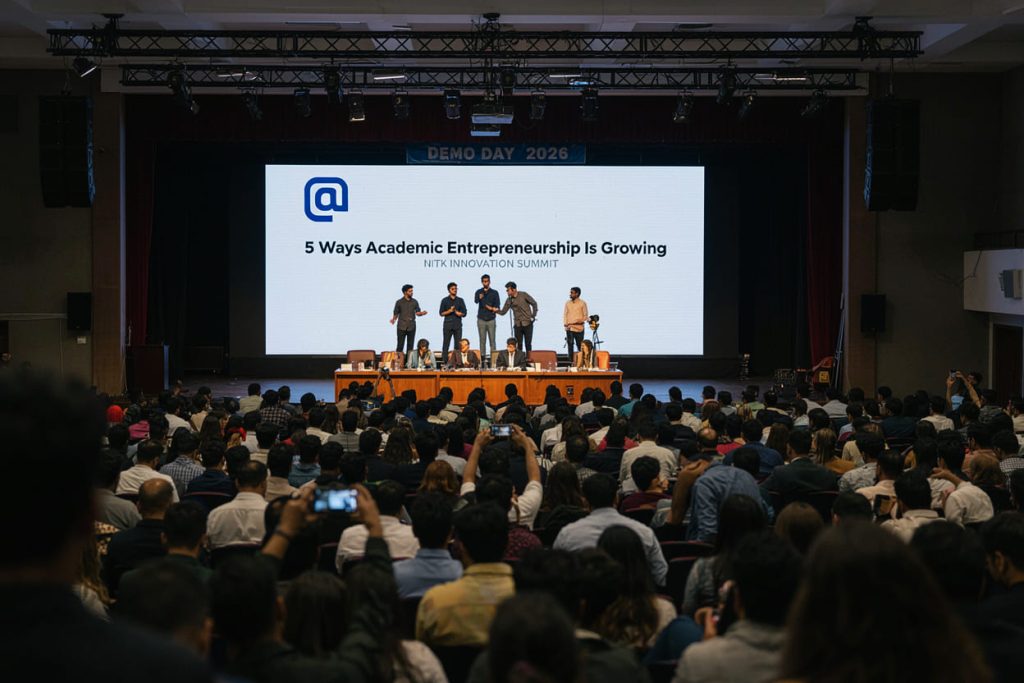
Table of Contents
5 Ways Academic Entrepreneurship Is Growing Through University Incubators in India


Indian campuses are no longer just producing graduates – they’re producing companies. Over the past decade, academic entrepreneurship has shifted from a fringe activity to a core part of how universities define their value, and university startup incubators are the engine behind that shift. From technology business incubators at IITs and NITs to newer cross-border partnerships, students and faculty are turning research into registered startups faster than ever. Here are five ways this ecosystem is expanding, and what it means for the future of Indian innovation.
1. Incubators Are Turning Labs Into Launchpads
Traditionally, a promising piece of academic research ended its life as a published paper. Today, university startup incubators exist precisely to stop that from happening. They give faculty and student researchers a structured path – mentorship, seed funding, legal support, and access to industry partners – to convert lab work into a viable product. Technology Business Incubators (TBIs) attached to institutes like NITs and IITs were among the earliest in India to formalize this, offering incubatees office space and structured evaluation milestones so a good idea doesn’t stall for lack of business know-how.
This matters because most researchers aren’t trained to think like founders. An incubator supplies the missing pieces – market validation, IP guidance, pitch coaching – so scientific talent doesn’t get lost in translation between the lab bench and the marketplace.
2. Government Policy Is Fueling Campus-Level Innovation
Academic entrepreneurship in India has not developed in silos. The Startup India initiative and the Atal Innovation Mission provided targeted funding for university incubators, motivating even small regional universities to establish their own incubators. This has taken some of the innovation authority away from a few top institutions and has decentralized it to tier-2 and tier-3 cities where local innovators earn a legitimate opportunity for commercialization.
The result is a broader base of academic startups solving hyper-local problems, rather than innovation clustering only around metro-based engineering schools.
3. Cross-Border Partnerships Are Opening New Doors
One of the more interesting recent developments is the rise of international university partnerships built specifically around entrepreneurship and applied research. The University of Toronto India Foundation (UTIF) is a good example – the University of Toronto’s Mumbai-based research and entrepreneurship centre, launched in 2023 with backing from Tata Trusts. UTIF works with Indian universities, governments, and entrepreneurs on sustainable urban development, pairing the University of Toronto’s research network with on-the-ground Indian expertise, and its programs span both collaborative research and startup mentorship.
Beyond joint research, UTIF’s entrepreneurship arm connects founders with mentors, professional networks, and opportunities to pilot solutions in real cities, giving Indian startups access to international academic backing without requiring them to relocate. Similar collaborations have formed between Indian incubators – like VIT’s Technology Business Incubator – and international partners, with founders crediting these ties for helping bridge homegrown research with global markets, particularly in cleantech and AI-driven ventures. This kind of cross-border model signals a shift: Indian university incubators are increasingly plugged into a global innovation network, rather than operating as isolated silos.
4. Startups Are Solving Urban and Sustainability Challenges
An increasing percentage of innovative startups born out of academic institutions are starting to focus on urban sustainability – water recycling, garbage disposal, mobility, climate resilience– over general consumer technology companies. This trend is due to both the priorities of financial backers and the available means with which India’s fastest-growing cities can adopt solutions that can be scaled up. Projects like School of Cities India are specifically aimed at conducting research and building capabilities to make the growth of Indian cities more sustainable, and incubated startup founders get to test it on an experimental basis before rolling out nationally.
5. Faculty Are Becoming Founders, Not Just Advisors
Possibly the most significant cultural change has been that faculties are taking up major founder or co-founder roles instead of sticking to their advisory positions. The universities have started revamping their incentive system to reward not only their commercial activities but also their patent work and startup creation besides their publications. Coupled with initiatives aimed at funding faculty members’ research, this transformation is turning professors’ research work into profitable ventures with support from academia, which traditionally did not lend that type of support.
The Road Ahead
University incubators in India are transforming from mere support offices scattered around campuses to game changers in ushering in funding, testing, and commercialization of research work. With the gumbo of government-led initiatives, private philanthropy, and international collaborations such as UTIF taking shape, academic entrepreneurship will also go far beyond the conventional territory of IIT and IIM and into a truly pan-India and globally-linked system.
Frequently Asked Questions
1. What is academic entrepreneurship?
Academic entrepreneurship refers to the process of turning university-based research, technology, or expertise into commercial ventures – typically led by faculty, researchers, or students, often with support from a university incubator.
2. What role do university incubators play in this process?
Incubators provide the infrastructure that pure research lacks: seed funding, mentorship, workspace, legal and IP support, and connections to industry. They act as a bridge between academic discovery and a market-ready product or company.
3. What is the University of Toronto India Foundation, and how is it connected to Indian incubators?
The University of Toronto India Foundation (UTIF) is the University of Toronto’s Mumbai-based research and entrepreneurship centre, launched in 2023 with support from Tata Trusts. It partners with Indian universities, Entrepreneurship Support Organizations, urban local bodies,and non-profit organizations on collaborative research and entrepreneurship programs focused on sustainable urban development, giving Indian founders access to international mentorship and networks.
4. Are university incubators only for engineering or tech students?
No. While many started with a tech and engineering focus, incubators today support ventures in healthcare, agriculture, sustainability, urban planning, and social enterprise, reflecting a much broader definition of “academic” innovation.
5. How has government policy supported university-led startups in India?
Programs like Startup India and the Atal Innovation Mission have provided funding and recognition for university incubation cells, encouraging even smaller and regional institutions to build formal entrepreneurship support systems, not just top-tier IITs and IIMs.