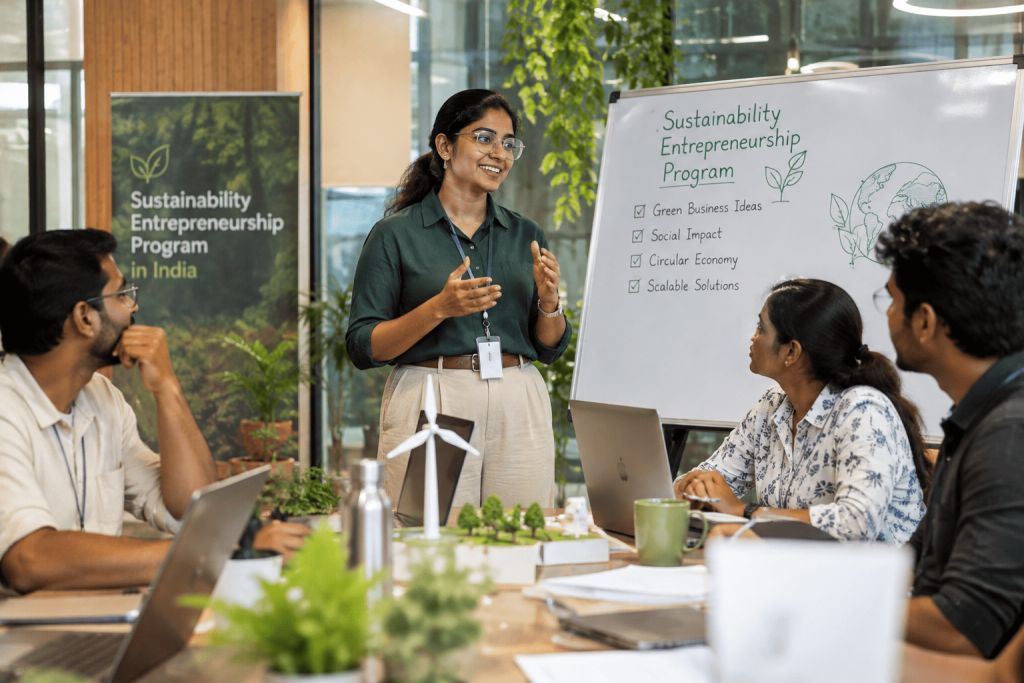
A sustainability entrepreneurship program in India gives early-stage founders the money, mentors and municipal access they need to test climate solutions in real cities. The UofT India Foundation runs this support in two stages, Innovate and Incubate, and in 2024-25 backed 12 startups with grants and pilot deployments.
Why do early-stage climate startups in India struggle to scale?
Capital reaches the sector, but little of it lands at the earliest stage. Climate-tech startups in India have raised roughly $12.8 billion since 2008 across 1,583 companies, according to Tracxn. In the first five months of 2026, however, five late-stage deals took $524 million, while seed-stage firms shared just $61 million across 44 rounds. That leaves many promising prototypes waiting for a first paying customer.
Cities add a second hurdle. The World Bank expects India’s towns and cities to house 600 million people by 2036, around 40 per cent of the population, yet the same report found that private sources fund only about 5 per cent of urban infrastructure. For a founder, the municipal body is often the buyer that matters most, and that wait can drain both savings and morale.
How does the UofT India Foundation programme close that gap?
It pairs funding with a direct route into real cities. The Innovate stage supports students and early-stage climate startups through university challenges, ideation help, mentorship and seed funding. The Incubate stage offers grant funding, technical mentorship and access to Urban Local Bodies (ULBs) for live trials. A Mumbai team builds the government and civil society partnerships, while University of Toronto faculty supply domain expertise.
How do the Innovate and Incubate stages compare?
| | Innovate | Incubate |
|---|
| Who it suits | Students and early-stage innovators | India-based startups ready for real-world pilots |
| Entry route | University partner challenges at IIT Bombay, IIT Madras and VIT-TBI | Foundation cohorts such as Techtonic, run with Social Alpha |
| Core support | Ideation help, mentorship, seed funding | Grants, technical mentorship, network access |
| Proof point | Carbon Zero Challenge: INR 40 lakh committed for five teams | Techtonic: INR 1,96,99,335 first tranche across 11 startups |
What did the 2024-25 Tectonic cohort actually receive?
Techtonic shows what full incubation looks like in practice. Launched with Social Alpha in August 2024, it drew 120 applications and selected 11 India-based startups after a three-stage review involving University of Toronto professors. Each startup received funding, a pilot deployment site, technical mentorship and capacity-building workshops. Pilots spanned five themes: energy, mobility, water and sanitation, air pollution and sustainable construction.
- Accelero Vehicles deployed 15 electric carts in Thiruvananthapuram and 75 electric pushcarts in Pune with SWaCH Co-op and Kashtakari Panchayat.
- RecycleX built eco-concrete roads with Bengaluru Cantonment and Bharuch Municipality.
- Solinas Integrity deployed water pipeline monitoring with Pimpri Chinchwad Municipal Corporation.
Who should apply to a sustainability entrepreneurship program in India?
Founders solving a measurable urban problem in one of six sectors should apply: waste management, air pollution, water and sanitation, energy efficiency, mobility or sustainable construction. Selectors on the Techtonic cohort scored applicants on innovation, market potential, business model scalability, pilot feasibility, team strength and potential impact. A realistic pilot plan therefore carries real weight, especially for startups entering the incubation stage.
Are you ready to apply?
- Students and idea-stage teams should start with a university partner challenge under Innovate.
- Pilot-ready startups should identify a likely partner, such as a municipal body or campus.
- Every applicant should define how they will measure environmental and social impact.
- Check the Entrepreneurship Programs page on uoftindiafoundation.com for open calls.
Choose your route before you write a word. Idea-stage teams should watch the university challenges, while pilot-ready startups should prepare for the next incubation cohort with a named city partner and clear impact metrics in hand.
Frequently Asked Questions
Is the programme only for students?
No. Students enter through partner challenges such as IIT Bombay’s Eureka! and the VIT-TBI Student Venture Program, while India-based startups join incubation cohorts such as Techtonic. Each route sets its own eligibility rules, so read the specific call carefully before you apply.
How much seed funding can early-stage founders expect?
It varies by route. Trinano Technologies won INR 2.5 lakh at IIT Bombay’s Eureka!, and the Carbon Zero Challenge committed INR 40 lakh across five teams. Techtonic’s first incubation tranche worked out to roughly INR 17.9 lakh per startup across the 11-member cohort.
Do founders get access to government buyers?
Yes, mainly through pilots. The programme confirmed four pilots with Thiruvananthapuram Municipal Corporation and two with Pimpri Chinchwad Municipal Corporation. Founders also attended an in-person workshop on government processes and procurement pathways, led by urban policy expert Jagan Shah in Bangalore.
What mentorship do University of Toronto experts provide?
Faculty give one-on-one technical guidance matched to each venture. Prof. Daman Panesar advised RecycleX on cement admixtures for stronger, more durable concrete, while Prof. Karan Singh mentored Panjurli Labs, MedCuore and Solinas Integrity on data architecture, visualisation and scalable, user-friendly interfaces.