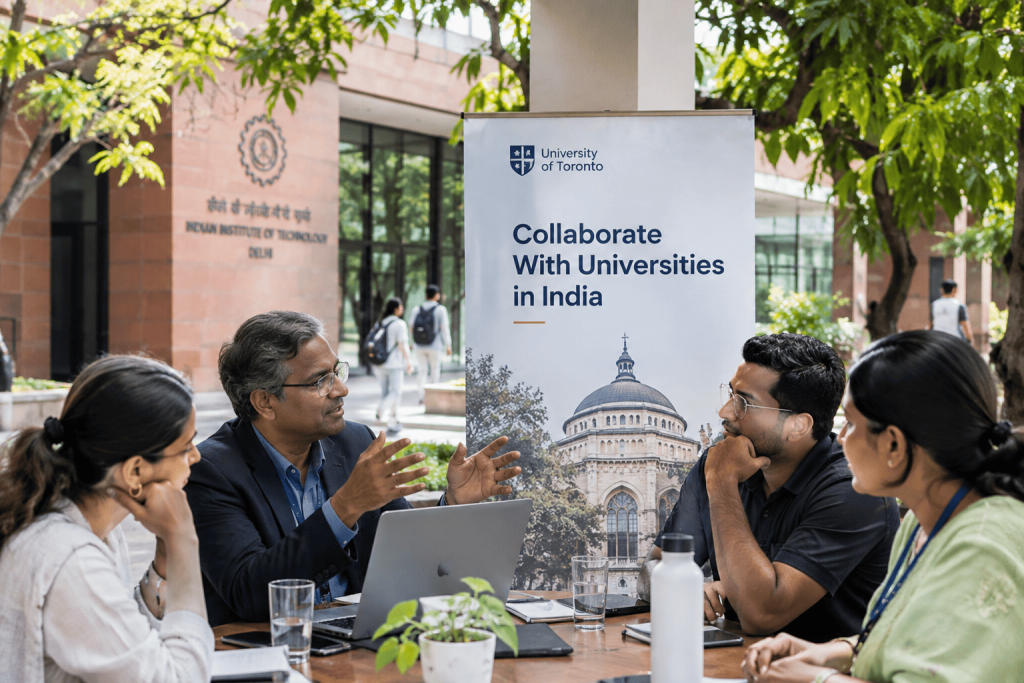
Every founder building hard technology in India meets the same wall. The prototype works, yet no buyer will commit without proof. A well-planned start up collaboration with a university breaks that wall, offering lab access, expert review and an institutional name buyers trust. This guide matches each route to your venture’s stage.
Why should startups partner with universities in India?
Universities give startups three assets that are hard to buy elsewhere: research depth, independent validation and trusted networks. Faculty can test a material, review a data model or question a business plan before investors do. Structured academic research partnerships in India also open doors to city bodies and industry buyers. For climate-tech founders, that credibility can decide who wins the first pilot contract.
What do university startup incubators in India offer founders?
These incubators provide structured support through a venture’s riskiest months. A typical package combines mentorship, prototyping grants, workspace and investor introductions, with faculty adding technical review. The student venture programme at VIT’s Technology Business Incubator shows the model at work. It was designed as a seven-month programme, from March to November 2025, moving student teams from ideation through pre-incubation towards commercialisation.
Which university partnership route suits your startup’s stage?
The right route depends on how far your product has travelled. Idea-stage teams gain most from business plan competitions, which bring expert feedback and cash prizes. Prototype-stage ventures should target challenges that fund proof-of-concept work. Market-ready startups need incubation linked to real deployment, where a city tests the product in the field. Each stage below draws on a recent Indian example.
Idea stage: business plan competitions
In October 2024, UTIF partnered with IIT Bombay’s E-Cell on the Energy and Sustainability track of Eureka!, reaching over 300 student ventures. Trinano, a solar panel coating startup, won INR 2.5 lakh from 115 applications.
Prototype stage: funded innovation challenges
The Carbon Zero Challenge with IIT Madras School of Sustainability drew 1,178 applications. UTIF committed INR 40 lakh to fund five teams with prototyping grants and follow-up seed capital.
Scale stage: incubation with city pilots
Techtonic, run with Social Alpha, selected 11 startups from 120 applicants, with University of Toronto professors on the review panel. Pilots followed with Urban Local Bodies in Thiruvananthapuram and Pimpri Chinchwad.
How do academic research partnerships in India help startups?
Research partnerships give startups access to specialists who can solve a technical problem the team cannot crack alone. The benefit is practical. Faculty review formulas, test assumptions and stress-test software before a public client sees it. This mentorship turns a promising product into a defensible one, which matters when procurement officers and investors start asking hard questions about safety and scale.
- Prof. Daman Panesar, a U of T cement chemistry expert, mentored RecycleX on its eco-concrete mix.
- Prof. Karan Singh advised Panjurli Labs, MedCuore and Solinas on data architecture in January 2025.
How should a start up collaboration with a university be structured?
Put every term in writing before work begins. A memorandum of understanding should name each party’s role, the funding amount, milestones and ownership of intellectual property. Agree on a regular review rhythm too. UTIF, for example, planned bi-monthly check-ins with Trinano to track progress after its award. Clear structure protects the relationship when timelines slip or approvals take longer than planned.
- Settle IP and trademark ownership early.
- Ask university startup incubators what support continues after the programme ends.
How does UofT India Foundation connect startups with universities?
The Foundation’s Mumbai team acts as a convenor and broker between Indian founders, academic institutions, government bodies and University of Toronto experts. Its entrepreneurship work runs in two phases: Innovate, offering ideation support, mentorship and seed funding, and Incubate, adding grants, technical mentorship and pilot access. In 2024-25, this model supported 12 startups with grants and pilot deployments, against an initial goal of four.
Choose the route that fits your current stage, not the one that sounds most impressive. Founders seeking university-backed mentorship, funding and pilot access can explore open calls with the UofT India Foundation at uoftindiafoundation.com.
Frequently asked questions
Can pre-revenue startups apply to university programmes in India?
Yes. Many university challenges welcome pre-revenue teams. The Eureka! Energy and Sustainability track and the VIT student venture programme both accepted ventures at early stages. Reviewers look at the idea, the team and its potential impact, so a sound plan and a working concept carry real weight.
Who owns the intellectual property in a university partnership?
Ownership depends on the agreement each side signs, so founders should settle IP terms in the MoU before any joint work begins. Expert guidance helps here. Techtonic founders attended an IP and trademark workshop and received a one-to-one follow-up consultation.
Which sectors do UTIF startup programmes focus on?
UTIF programmes centre on climate resilience, sustainable urban infrastructure and data-driven sustainability. The 2024-25 Techtonic cohort covered sustainable construction materials, water and sanitation, energy, air pollution and mobility, with each startup solving a specific problem that Indian cities face today.
How long does a university incubation programme in India last?
Durations vary by programme. VIT’s student venture programme spans seven months, while the Carbon Zero Challenge ran from applications in early 2025 to a grand expo planned for August. Match the programme timeline to your own product milestones before applying.