
University of Toronto India Foundation

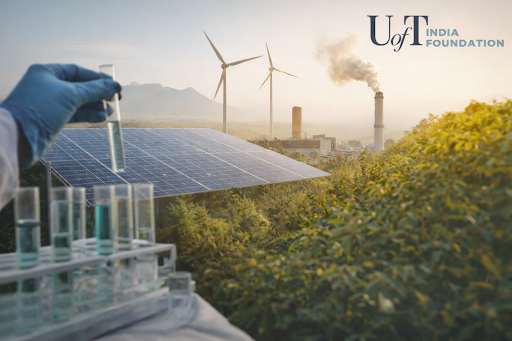
Research Projects in India on Climate, Environment and Energy


In order to meet India’s challenges of climate change, the environment and energy, we need a solid basis of scientific research to provide solutions. As India faces the dual demand for rapid economic growth and environmental sustainability, there is a need to conduct research that answers questions related to the implementation of renewable energy technologies, adaptation strategies for climate change, restoration of degraded environments and the development of sustainable urban systems. The research that is being conducted today in India has changed significantly over the past few years; the collaboration between Indian and international research institutions has resulted in multiple types of evidentiary support that informs policy-making, stimulates innovation and develops capacity for sustained action.
A thorough understanding of India’s current research activity will provide insight into the complexity of research being undertaken and will create new opportunities for both new researchers and institutions, as well as allow new organizations to create knowledge that will help to solve India’s most pressing sustainability issues.
The Research Imperative
India is experiencing an acute effect of climate change through increasing temperature and variability in rainfall, extreme weather events becoming more frequent and severe, and rising sea levels threatening agriculture, water security, coastal communities and urban infrastructure, along with an urgent need for energy transition (from reliance upon fossil fuels to renewable energy sources) to achieve the goals of the Paris Agreement which requires an understanding of the technical, economic, social and political dimensions to transitioning to renewable energy sources. Further, the impact of air pollution, contamination of water, and habitat destruction on the environment will require evidence-based restoration efforts to address these issues at both the community and regional levels.
Research projects being conducted throughout India in each of these areas will provide the most effective foundation upon which to make well-informed decisions; however, a successful research project must not only investigate the issues, but it must translate the results into action-based recommendations, develop capacity to conduct research within communities, and have a focus on addressing community-related research issues versus simply adapting research from a global context.
Collaborative Research Models
The University of Toronto India Foundation serves as an example of how collaborating globally through an established set of research cooperatives can strengthen the research ecosystem. The University of Toronto Foundation has established a series of Research Catalyst Grants, which support collaborative research projects that utilise the faculty’s expertise from the University of Toronto and combine it with the contextual knowledge and capacity for implementation of Indian partner organizations. The result is that the research created through this method provides both methodological rigour and is relevant to the indigenous locale in which it is performed.
Research projects in India performed through this cooperative have addressed various sustainability issues. For example, one research project looked at Odisha’s successful transition from intermittent to continuous water delivery and identified factors that can be replicated by other municipalities which could achieve a similar transition. Other research projects focus on sustainable agriculture practices and conserving seed resources, linking food security in urban centres with the resilience of farming communities. Finally, a third research project looked at the use of assistive mobility devices for children with disabilities, illustrating how sustainability research is not solely limited to physical and environmental concerns, but is grounded in the social aspect of inclusive development.
These projects have several commonalities: they are responding to major issues facing Indian communities; they are utilising Indian organizations as equal partners, instead of as study subjects; and they are creating outputs, including policy briefs, methodologies and community resources, that will be used by other groups beyond academic audiences.
Also Read: Building Impact: UofT India Foundation’s Support for Research & Startups
Urban Sustainability Research
The large urban population of India is expected to continue to grow and is projected to reach over 600 million people by 2036. Research is increasingly being done in order to promote sustainable urbanization in light of the future growth of urban populations in India. The UofT India Foundation has supported research that examines issues associated with urban heat, improving air quality, developing innovation in waste management and infrastructure development that is equitable.
Research on UHI and heat mitigation planning is being done in conjunction with other organisation’s like Mahila Housing Trust, which informs strategies on how to keep vulnerable populations safe during extreme heat. As climate change continues to create new records in terms of the heat people are being exposed to, this research is literally saving lives by identifying areas with the largest population of people who are the most vulnerable and what intervention techniques, such as cool roofs, green spaces and early warning systems, provide the most successful outcomes.
Research on air quality is one of the most visible threats to the environment in India. Research is being conducted to identify sources of pollution, how particulate matter travels in the atmosphere, the health effects associated with pollution and the effectiveness of interventions. There are also research studies that are focused on the effectiveness of technology-based solutions, such as industrial filtration and emission controls. Additionally, there are studies that look at the behaviour of social policies and how government-supported policy frameworks impact the effectiveness of the two technology-based solutions mentioned previously.
Energy Transition Research
India’s energy transition represents one of the most consequential sustainability efforts globally. Research projects in India need to span renewable energy technologies, grid integration challenges, energy storage solutions, policy frameworks enabling transition, and social acceptance of energy system transformations.
Solar and wind energy research addresses technical questions, improving efficiency, reducing costs, managing intermittency, alongside investigations into financing mechanisms, land use implications, and employment impacts on communities dependent on fossil fuel industries. Recognising that just transitions require attending to workers and communities affected by energy shifts, research increasingly examines social dimensions alongside technical ones.
The UofT India Foundation Programs support research examining energy systems at multiple scales: building-level efficiency, neighbourhood microgrids, municipal energy planning, and regional grid management. This multi-scalar approach recognises that energy transitions occur simultaneously at different levels, each presenting distinctive challenges and opportunities.
Climate Adaptation Research
Adaptation investigations look at various factors to create resilience in communities and systems and to build resilience to the impacts that are already evident from climate change. Examples include: an agricultural adaptation research project, investigations into water resource management under climate change, and infrastructure design that develops solutions for extreme weather events.
Agriculture has an important research role to play and will be particularly important to agriculture, as agriculture will experience most of the direct impacts of climate change. These include: the development of drought-tolerant crop varieties, the development or dissemination of water-efficient agricultural irrigation technologies, the use of climate forecasting information for agricultural decision-making, and the development of crop insurance mechanisms to reduce uncertainty for farmers. For example, UofT Foundation India is doing research on traditional rice varieties and sustainable farming techniques to connect traditional knowledge to present-day climate change challenges.
An urgent requirement to address adaptation research in the coastal regions of India is the danger that sea levels will rise or cyclones will increase. Studies assess the effectiveness of nature based adaptation strategies, such as restoring mangrove forest, and engineering based adaptation strategies, such as enhancing coastal infrastructure, as well as building community resilience. The imminent need for adaptation is especially pressing given that millions of people in India live in coastal regions that are vulnerable to climate change impacts.
Building Research Capacity
Beyond specific investigations, research projects in India benefit from increasingly emphasised capacity building. The University of Toronto India Foundation conducts workshops on urban data visualisation, mixed-methods research, and analytical tools, strengthening Indian researchers’ capabilities to design and execute sophisticated studies.
The foundation’s Urban Mixed Methods Workshop brings Indian doctoral students to Toronto for intensive training in cutting-edge methodologies. Fellowship programs enable extended engagement with University of Toronto faculty, creating mentorship relationships extending beyond individual workshops. These capacity-building initiatives recognise that sustainable research ecosystems require not just funding individual projects but strengthening institutional and human capabilities.
Partnerships with institutions, including TISS Mumbai, IIT Madras, and NIAS Bangalore, create distributed research capacity across geographies and institutions. Rather than concentrating expertise narrowly, this approach builds broad-based capabilities, ensuring diverse communities and contexts receive research attention.
Translating Research to Impact
The true value of research is determined by its impact (e.g., policies that are developed because of the research, how innovations are developed because of the research, and/or practices that are improved as a result of the research). As such, research projects conducted by India increasingly include an emphasis on mobilising knowledge (e.g., developing policy briefs, convening stakeholder meetings for discussion purposes, developing easily understandable summaries of the research project, and forming partnerships to help ensure that the research gets to the individuals who are making decisions).
The UofT India Foundation is facilitating this translation of research into practical applications through events like the AI and the City Conference (which brought researchers and practitioners together) and platforms like the SOCIAL Speak Series (a forum to allow a wider audience to view/review research). These types of initiatives acknowledge that while quality research can create significant value, it is only valuable when it is made available to individuals outside of the academic community.
The Path Forward
As India confronts intensifying climate and environmental challenges while pursuing development aspirations, the research projects in India will only grow more critical. The questions demanding investigation become more complex, requiring interdisciplinary approaches, sophisticated methodologies, and genuine collaboration between researchers and communities affected by challenges being studied.
Organisations like the University of Toronto India Foundation demonstrate how international partnerships strengthen research capacity while ensuring investigations address locally relevant questions. By supporting collaborative research, building researcher capabilities, and facilitating knowledge translation, such initiatives help ensure India develops the evidence base needed for informed, effective climate and sustainability action.
The next generation of research projects in India will determine whether the nation navigates climate transitions successfully. Ensuring these investigations combine rigour with relevance, build capacity alongside generating knowledge, and translate findings into impact represents the research imperative for India’s sustainable future.


