University of Toronto India Foundation

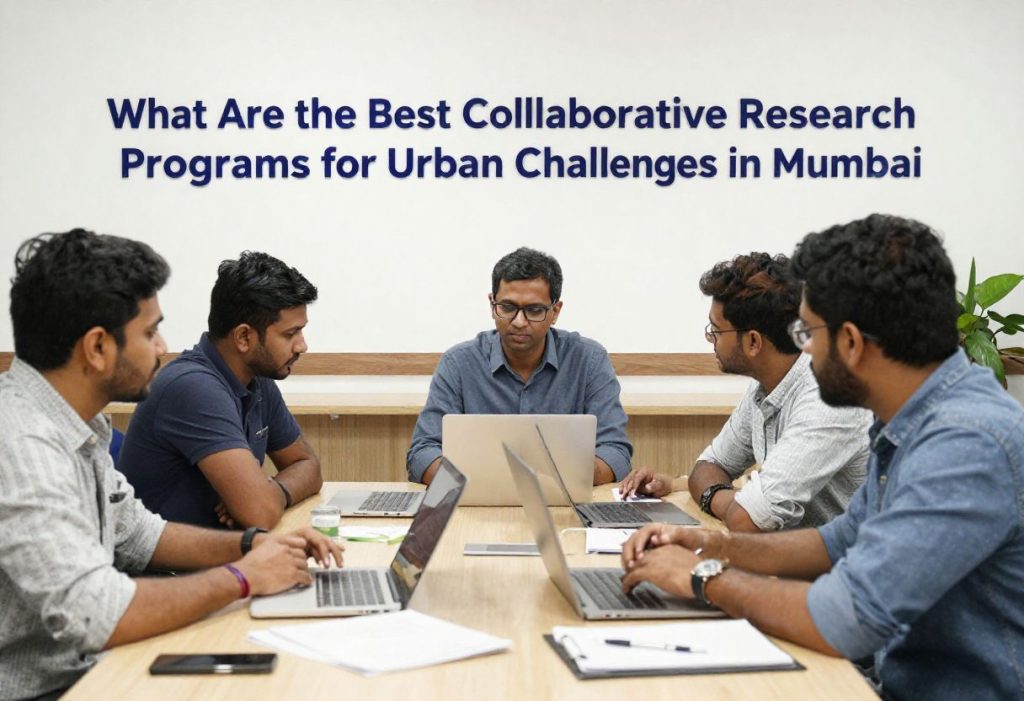
Table of Contents
What Are the Best Collaborative Research Programs for Urban Challenges in Mumbai?


Mumbai is dealing with urban problems of huge scale: despite being situated in coastal zone there is water shortage, air pollution affecting millions, housing crisis due to rapid increase in population, waste management hit by daily production of 12,000 tonnes, transport congestion on the road, and worsening impacts of climate, such as heat stress and floods. All these problems require serious scientific research providing evidence for policies and practices. Gladly, Mumbai has become a center for cooperative research projects dealing with urban sustainability with different institutes, foreign partners and government organizations working together to provide solutions effective not only in India but also worldwide.
For researchers seeking to engage with Mumbai’s urban challenges, understanding available research programs proves essential. Multiple pathways exist- some university-based, others foundation-supported, many involving international collaboration. The University of Toronto India Foundation’s programs represent particularly valuable opportunities, combining rigorous research with implementation focus and international expertise.
Top Research Programs Operating in Mumbai
University of Toronto India Foundation’s Research Catalyst Grants stand as premier opportunity for Mumbai-based researchers. Through partnerships with Tata Institute of Social Sciences (TISS) and other Mumbai institutions, the foundation supports collaborative investigations between University of Toronto faculty and Indian researchers on sustainable urban development, water security, climate resilience, and inclusive development. Recent projects examine placemaking in underutilized urban spaces, waste-picker cooperative models, and equitable infrastructure access.
The foundation’s partnership with TISS- India’s leading institution focused on social sciences and development- provides Mumbai researchers with access to both international expertise and strong local institutional support. TISS faculty bring a deep understanding of Mumbai’s communities, existing partnerships with civil society organizations, and research infrastructure enabling rigorous investigation.
TISS Mumbai’s Research Programs extend beyond UofT collaboration. The School of Habitat Studies conducts research on housing, urban development, and sustainable cities. The School of Social Work investigates community development and social equity dimensions of urbanization. TISS researchers frequently partner with international institutions while maintaining focus on Mumbai and South Asian contexts.
Mumbai’s Academic Institutions’ Urban Research Centers including programs at IIT Bombay, University of Mumbai, and Ashoka University’s Mumbai campus conduct research addressing city challenges. These programs often welcome collaborations with international researchers and can serve as Indian partner organizations for international funding.
Partnership between NGOs and academic institutions is a different method of undertaking and conducting investigations. Organizations like SWaCH (a cooperative for garbage picking), Development Alternatives, and several community groups are working together with educational facilities to realize research aimed at documenting their work and finding evidence for the possible scaling-up of their activities. Thus, the joined efforts of academic institutions and communities combine knowledge gained through research with real-life usage.
Government-aligned research initiatives imply programs implemented by Mumbai Municipal Corporation, the Maharashtra Water Supply and Sewerage Board (MWSSB), as well as other public bodies providing grants and assistance in research of particular problems. Local authorities start recognizing advantages of relying on research while improving service delivery and making decisions in the area of public policy.
Key Urban Challenges Research Programs Address
Water Security: Research programs investigate Mumbai’s paradoxical position- surrounded by water yet facing severe scarcity. Studies examine wastewater treatment and recycling, water supply optimization, groundwater depletion, and stormwater management. The UofT India Foundation’s interest in water management systems positions such research as priority.
Waste Management Systems: Multiple research programs document informal waste-picker networks, examine formalization pathways, investigate waste processing innovations, and study behavioral dimensions of waste segregation. Research on SWaCH- documented through collaborations like the International Multidisciplinary Urban Capstone Program- provides models for other cities.
Housing and Slum Upgradation: Research examines in-situ upgrading approaches, examining how to improve conditions for inhabitants of informal settlements while avoiding displacement. TISS research on housing particularly contributes to understanding community needs and participatory approaches.
Transportation and Mobility: Research investigates public transportation effectiveness, pedestrian safety, cycling infrastructure, and equitable mobility access. Studies examine how transportation investments affect different communities and how planning can serve all residents.
Heat Resilience and Climate Adaptation: Research programs increasingly focus on heat action planning, cool infrastructure deployment, and community vulnerability assessment. Climate adaptation research proves increasingly urgent as heat waves intensify.
Air Quality and Health: Research documents pollution sources, health impacts, and intervention effectiveness. Studies combine environmental monitoring with epidemiological investigation and policy analysis.
Accessing Mumbai's Research Programs
Researchers interested in engaging with these programs should:
Identify Research Questions: Define specific urban challenges you want to investigate. The more specific your question, the easier to identify appropriate programs.
Contact Institutions: Reach out to TISS, IIT Bombay, University of Toronto India Foundation, or relevant NGOs with your research interests. Most institutions maintain research offices or faculty contacts welcoming collaboration inquiries.
Explore Funding Opportunities: The UofT India Foundation’s Research Catalyst Grants explicitly welcome Indian researchers developing partnerships with Canadian faculty. Additionally, government schemes, foundation grants, and international funding support urban research.
Build Partnerships: Strong research requires collaboration. Identify potential Indian and international collaborators aligned with your interests. The UofT India Foundation facilitates such connections through webinars and direct engagement.
Seek Institutional Support: Your institution likely maintains research office support. Engage these resources for identifying funding, developing proposals, and managing grants.
Frequently Asked Questions
Q: What makes the UofT India Foundation’s programs particularly valuable for Mumbai researchers?
A: The Research Catalyst Grants combine international funding with equal partnership positioning- Indian researchers lead investigations with University of Toronto collaborators rather than serving supporting roles. Additionally, the foundation’s focus on sustainable urban development directly aligns with Mumbai’s challenges. Funding flows directly to Indian partner organizations, strengthening institutional capacity. Mentorship from U of T faculty provides international expertise while capacity-building workshops strengthen research capabilities.
Q: Can I apply for UofT India Foundation grants if I’m not at a major institution?
A: Yes. While TISS partnership provides particular advantages, the foundation accepts applications from researchers at various institutions and from NGOs. What matters is research quality, partnership authenticity, and alignment with program priorities. If your research addresses sustainable urban development and you can establish genuine partnership with University of Toronto faculty, you can apply.
Q: How competitive are Mumbai research programs?
A: Very competitive. The UofT India Foundation Research Catalyst Grants have acceptance rates around 20-25%. However, competitiveness reflects program quality rather than suggesting you shouldn’t apply. Strong proposals addressing genuine research questions with well-articulated partnerships succeed regularly. Even if not funded, feedback from evaluation processes helps strengthen future proposals.
Q: What’s the typical timeline from proposal submission to research commencement?
A: For the UofT India Foundation Research Catalyst Grants, proposals are typically due in February, with results announced in March and funding beginning in April. Total timeline from submission to fund receipt often spans 2-3 months. This timeline allows researchers to plan effectively while maintaining program efficiency.
Q: How do I identify potential University of Toronto collaborators for research proposals?
A: The UofT India Foundation conducts webinars helping researchers identify collaborators. You can browse U of T faculty directories and research profiles on the university website. Alternatively, contact the UofT India Foundation directly- they facilitate introductions between researchers seeking collaborations and U of T faculty interested in India-based investigations.